Is Arabic Pronunciation Really That Hard? Deconstructing the Myths and Mechanics
If you have ever tried to learn Arabic, you have likely encountered the "throat hurdle." You try to say a word like qalb (heart), but it comes out as kalb (dog). You try to say ḥaflah (party), but it sounds like you are just clearing your throat.
Many learners ask: Is Arabic pronunciation objectively hard, or is it just me?
The short answer is: It is true that it is difficult, but not because the language is trying to trick you. It is difficult because Arabic requires you to use parts of your vocal tract that usually lie dormant in other languages.
Here is the scientific and linguistic breakdown of why Arabic pronunciation feels so "hard" and what is actually happening in your mouth.
1. The "Guttural" Workout: Engaging the Throat
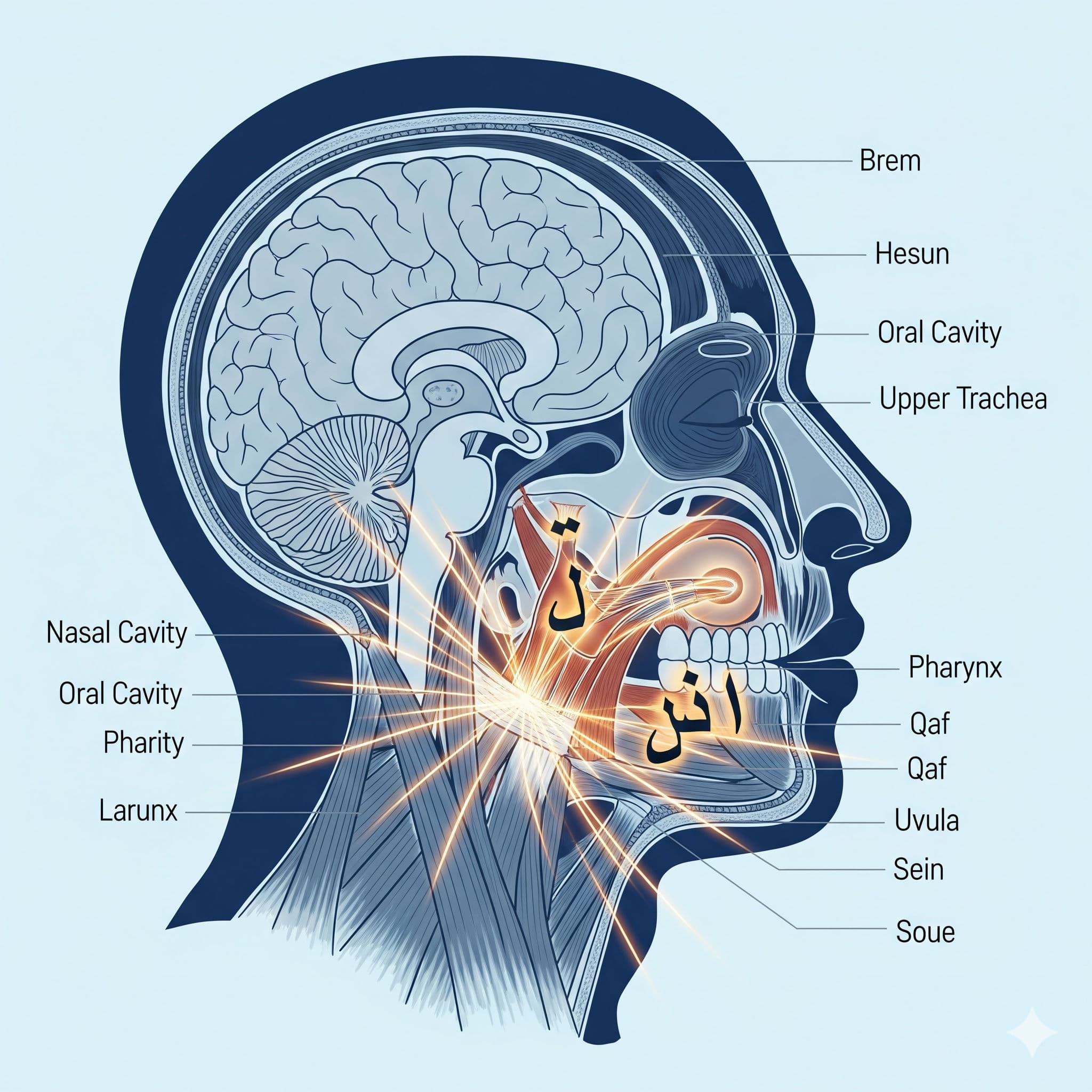
The most infamous difficulty in Arabic is the existence of guttural sounds—sounds produced deep in the throat. In English, we mostly speak from the front of the mouth (lips, teeth, and tongue tip). Arabic, however, demands that you move the sound production backward.
- The ʿAyn (ع): This is often cited as the hardest sound for foreigners. It is a voiced pharyngeal fricative. To pronounce it, you must constrict the muscles deep in your throat (the pharynx) as if you are being strangled or gagging slightly. English has no equivalent for this.
- The Ḥaa (ح): Imagine fogging up a mirror with your breath, but tighten your throat to make the air hiss louder. That is the ḥaa. It is much sharper than the English "H."
- The Ghayn (غ) and Khaa (خ): These are uvular sounds, produced at the very back of the roof of the mouth (the uvula). The ghayn is similar to the French "R" (as in Paris), and the khaa is like the distinct sound in the Scottish Loch or German Bach.
Why it feels hard: It is a muscular issue. You are asking your throat muscles to perform acrobatics they have never done before. Just like doing the splits takes flexibility training, speaking Arabic takes "throat training."
2. The Heavy vs. Light Letters (Emphatics)
In English, the letter "S" is just "S." In Arabic, there are two "S" sounds, two "T" sounds, two "D" sounds, and two "Th" sounds.
These are known as Emphatic Consonants (Mufakham).
- Light: Seen (س) is a normal "S" (like in soft).
- Heavy: Saad (ص) is a deep, heavy "S."
To make the heavy sound, you must raise the back of your tongue toward the roof of your mouth (a process called velarization or pharyngealization). This gives the sound a hollow, "dark" quality.
The Danger: If you mix them up, you change the meaning.
- Seif (sword) vs. Sayf (summer).
- Teen (figs) vs. Tteen (mud).
3. The "Q" vs. "K" Trap
Arabic distinguishes between Kāf (ك) and Qāf (ق).
- Kāf is exactly like the English "K" (as in kite).
- Qāf is a uvular sound. You must click the back of your tongue against your uvula (the hanging thing in the back of your throat).
For English speakers, these two often sound identical, but to an Arab ear, they are as different as "B" and "P." Confusing them can be disastrous—most famously, the difference between Qalb (heart) and Kalb (dog). You generally want to tell someone "I love you with all my heart," not "all my dog."
4. The Vowel Timing (Short vs. Long)
English is a stress-timed language; we often "eat" our vowels or turn them into a "shwa" sound (uh). Arabic is strictly timed regarding vowel length.
- Short vowel: Kataba (he wrote).
- Long vowel: Kaataba (he corresponded with).
Holding a vowel for 0.5 seconds versus 1.0 second changes the entire grammar and meaning of the sentence. This requires a level of rhythmic discipline that feels unnatural to English speakers who are used to slurring vowels together.
Conclusion: It is Muscle Memory, Not Magic
So, is the rumor true? Yes. Arabic pronunciation is hard for English speakers because it has a high "physicality." It requires:
- New Muscle Groups: Activating the pharynx and epiglottis.
- Fine Motor Control: Distinguishing between different tongue positions for "heavy" letters.
- Rhythmic Precision: Respecting vowel lengths.
However, it is not impossible. It does not require a special gene. It simply requires treating language learning like gym training. Your throat will literally get sore at first, but once those muscles develop, the sounds that once seemed impossible will become second nature.
Ready to Start Your Arabic Journey?
Join thousands of learners on ArabiUp and start mastering Arabic today. Get access to interactive lessons, gamified practice, and a supportive community—all for free!
No credit card required • Join 10,000+ learners